

Insider Guide: The Tokyo Marathon Route

Why Run the Tokyo Marathon?
The Tokyo Marathon is far more than just a race, it’s one of the most unforgettable events on the global marathon calendar. Every year, thousands of runners travel across continents to experience the energy, precision, and atmosphere that make this event so unique. From the moment you arrive in Japan, marathon week takes over the city, creating an excitement that builds all the way to the start line.
In this guide, I’ll break down the entire marathon route, point out the top sights along the way, explain what to expect from the course profile, and share practical tips to help you approach race day with confidence.
I’ll also cover the three concerns that often weigh on runners’ minds before taking on Tokyo: strict cut-off times, hydration strategy, and those infamous switchbacks, so you can line up at the start fully prepared
Since its debut in 2007, the Tokyo Marathon has grown into one of the crown jewels of the Abbott World Marathon Majors. Famous for its flat course and electric atmosphere, the race begins beneath the towering Tokyo Metropolitan Government Building in Shinjuku before weaving through some of the city’s most iconic districts, including Asakusa, Ginza, and Nihonbashi, before finishing beside Tokyo Station and the Imperial Palace.
What makes Tokyo unique is the contrast between modern skyscrapers, historic temples, and impeccably organised race operations. Every section of the course feels carefully designed, with huge crowds lining the streets from start to finish and creating an atmosphere that constantly carries runners forward.
I travelled to Tokyo with Sports Tours International, a specialist tour operator that takes runners to major marathons around the world. For a race like the Tokyo Marathon, widely regarded as one of the hardest marathons on the planet to gain entry to, travelling with a tour operator offers a rare opportunity to secure a guaranteed place without relying on the competitive ballot system.
Tokyo Marathon Race Morning
I’d spent the entire week leading up to the marathon battling nerves, but the moment I arrived near the Tokyo Marathon start line, all of that disappeared. You’re immediately surrounded by thousands of runners from all over the world, and there’s something strangely calming about sharing the same goal with everyone around you.
Travelling with Sports Tours International made the entire morning seamless. Coaches transport runners directly from the hotel to the start area, removing the stress of navigating Tokyo’s transport system.
Although it’s an early start, Tokyo Marathon morning is usually cool rather than freezing, so most runners only need a throwaway hoodie or light layer while waiting in the corrals.
What stands out immediately is how incredibly organised everything is. Despite the sheer scale of the event, security, bag drop, and toilet queues move surprisingly quickly and are clearly signposted. Volunteers are everywhere, guiding runners, handing out water, and offering the famous Pocari Sweat sports drink, which is also available throughout the marathon course.
Many runners bring empty 250ml soft flasks (max 2 allowed) or hydration bottles and simply fill them before the race, making hydration far easier than many expect.
Before long, you’re standing in your start corral surrounded by music, waving volunteers, and an atmosphere buzzing with anticipation. Once the race officially begins, the corrals slowly edge forward and, depending on your wave, it can take around 10 minutes before you finally reach the famous start line beneath the towering Tokyo Marathon signage.
Then suddenly, it happens. You cross the line and within seconds you’re running through the streets of Tokyo.

The Tokyo Marathon Race Course
The Tokyo Marathon course doubles as a full sightseeing tour of the city. It’s largely an out-and-back route featuring long straights, sweeping boulevards, and several memorable switchbacks that become one of the defining characteristics of the race. Key highlights include:
Start – Shinjuku
Beginning outside the Tokyo Metropolitan Government Building
Early downhill section
A gentle descent into the city that makes it easy to settle into rhythm
Kanda & Nihonbashi
Historic districts blending traditional and modern Tokyo
Asakusa turnaround
Passing close to the famous Sensō-ji temple
Ginza
Sleek modern streets lined with spectators
Shinagawa turnaround
Home to one of the course’s longest straight sections
Final stretch to Tokyo Station
Finishing beside Tokyo Station and the Imperial Palace


Tokyo Marathon Course Elevation
The Tokyo Marathon is often described as flat, and compared to many Abbott World Marathon Majors, it absolutely is, but that doesn’t mean it feels effortless. In fact, many runners comment afterwards that the course feels hillier than expected.
With roughly 60 metres of total elevation gain across the entire course, Tokyo is considered one of the flattest races among the Abbott World Marathon Majors.
There are no major climbs, but the long straights, subtle rises, and accumulated fatigue still demand respect over the final 10K.
First 5K:
A noticeable downhill section ideal for settling into pace, although congestion can make it difficult to find rhythm early on
5K-25K:
Mostly flat with gentle undulations
25K-35K:
Small rises and overpasses begin to fatigue the legs
Final 7K:
Flat on paper, but significantly tougher due to accumulated fatigue
There are no brutal hills, but over 26.2 miles even small inclines begin to add up. Late in the race, short road rises can feel surprisingly punishing.


Tokyo Marathon Course Switchbacks
The course includes four major out-and-back sections, featuring several 180-degree switchbacks. Early in the race, these sections add to the spectacle as you see thousands of runners flowing in the opposite direction.
Later on, however, they become one of the biggest mental challenges of the race, especially beyond 30K when the turnaround points seem endlessly far away.
The roads in Tokyo are incredibly smooth and fast, making it an excellent course for chasing a personal best. But the course is also more exposed than many runners expect, with very little shade, if the sun is out, you’ll feel it. Watch our got constant movement from runners weaving and overtaking throughout the race.
Strict Cut-Off Times
One of the biggest concerns runners have before Tokyo is the cut-off system.
The full marathon has a seven-hour time limit, starting from the official 9:10 AM start time, with several intermediate checkpoints along the route. Runners who fall behind the required pace at these checkpoints may be removed from the course, so it’s important to keep an eye on your pacing throughout the race. We’ve worked out that if you can comfortably complete a marathon in around six hours, you shouldn’t need to worry about the cut-off times. In fact, as you progress through the course, the checkpoint cut-offs become slightly less strict.
Aid Stations & Fuel
Aid stations appear roughly every 5K and are exceptionally well organised.
You’ll find:
- Water and Pocari Sweat throughout the course in paper cups ( Early tables can become congested, so moving further down the station often helps)
- Pre-cut bananas
- Sweet and savoury local snacks
- Small treats like custard-filled pancakes and salt candies
Due to the warmer conditions experienced in previous years, organisers also provided runners with reusable soft cups at bib collection. Many runners clipped them onto belts or vests to carry extra water at aid stations or pour water over themselves later in the race.
One thing worth noting: some portable toilets are positioned slightly away from the main course route, occasionally down side streets. If you spot one and think you may need it, don’t assume another will appear quickly.
Costumes, Culture & Atmosphere
Much like the TCS London Marathon, many runners take part in elaborate costumes, adding another layer of entertainment throughout the course.
Combined with traditional drummers, cheering spectators, and live performances, the atmosphere constantly evolves as you move through different districts of Tokyo.
Tokyo is sometimes described as quieter than races like the TCS New York City Marathon, but that doesn’t mean the support is lacking. From halfway onwards, the atmosphere steadily builds.

The Tokyo Marathon Finish
The marathon finishes on Gyoko-dori Avenue near Tokyo Station and the Imperial Palace, delivering one of the most iconic finishing backdrops in marathon running.
The final approach feels incredibly dramatic, especially with crowds packed along the barriers and the famous red-brick Tokyo Station building directly ahead. The closing section also includes a short cobbled stretch, adding one final challenge before the finish line.
42.1 km Course
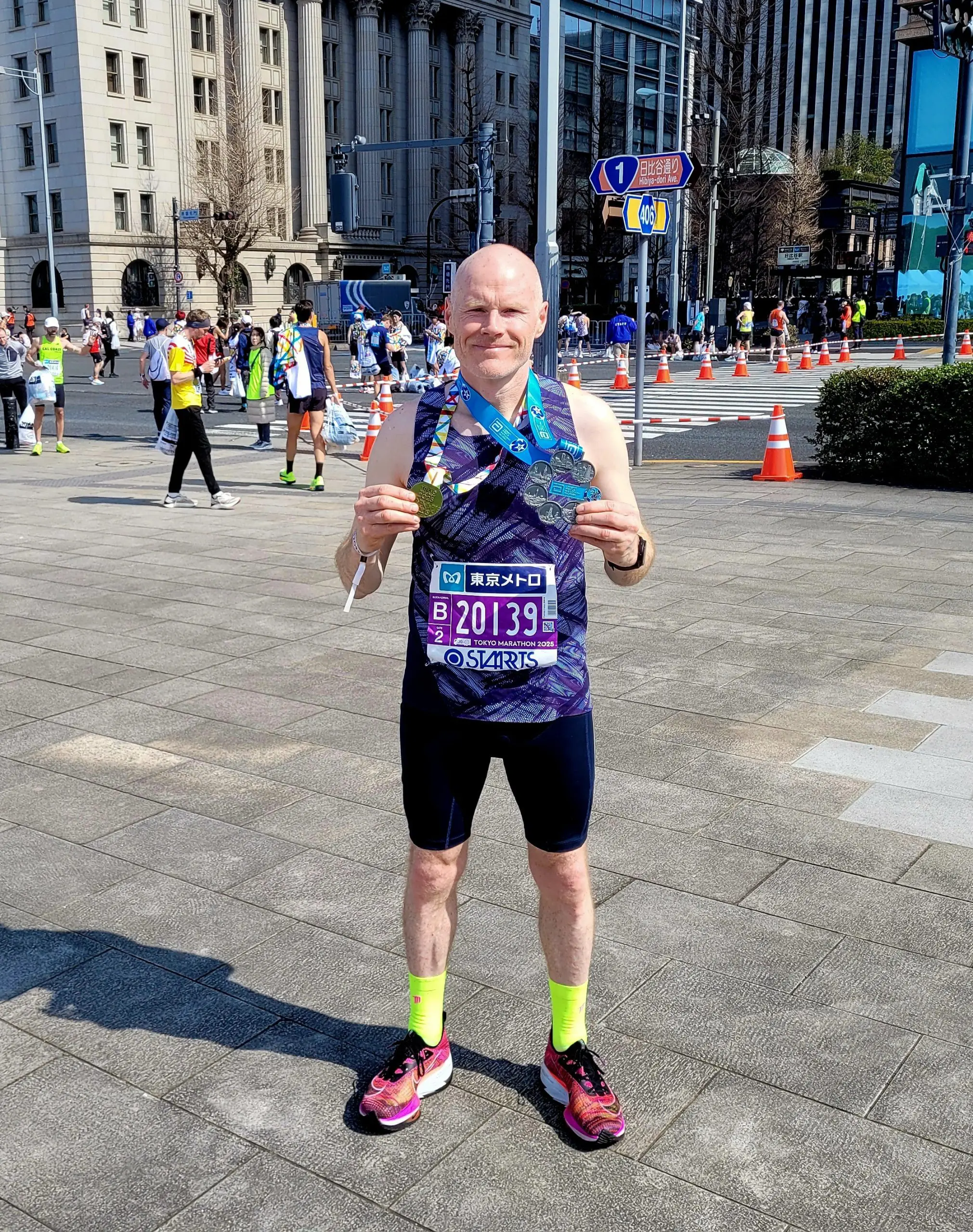
Volunteers immediately greet you with your medal, you’re then guided through an incredibly efficient finish system to collect your bag. Every runner receives recovery items, snacks, hydration, bath salts, recovery products, and the famous Tokyo Marathon finisher towel.
For runners travelling with Sports Tours International, coaches transport runners directly back to their hotels after the race, something that feels like an absolute lifesaver after running a marathon.
Before long, you’re back recovering before the celebrations continue at the Tokyo Marathon after-party, complete with local entertainment, incredible buffet style food, and hundreds of runners sharing stories from the day.

The Tokyo Marathon Is Truly Special
The Tokyo Marathon is fast, scenic, and deceptively challenging. Between the flat profile, mentally demanding switchbacks, and world-class organisation, it delivers a marathon experience unlike any other.
If you’re looking to secure your place while experiencing marathon week as part of a global running community, Sports Tours International offers everything from shakeout runs and race briefings to sightseeing tours, race-day logistics, and unforgettable post-race celebrations, helping runners enjoy every part of the Tokyo Marathon experience stress-free. Sign up here.

50+ Years
Since 1973, Sports Tours International has been taking runners and cyclists to the world’s greatest events
